

Oceans North Kalaallit Nunaat (ONKN) is a Greenlandic environmental NGO and non-profit charitable organization that promotes marine protection and sustainable use of marine living resources in partnership with Greenlandic society.
ONKN has taken note of the Norwegian Ministry of Energy’s announcement of the first licensing round for seabed minerals on the Norwegian continental shelf, which is now open for public consultation with deadline on 26 September 2024.
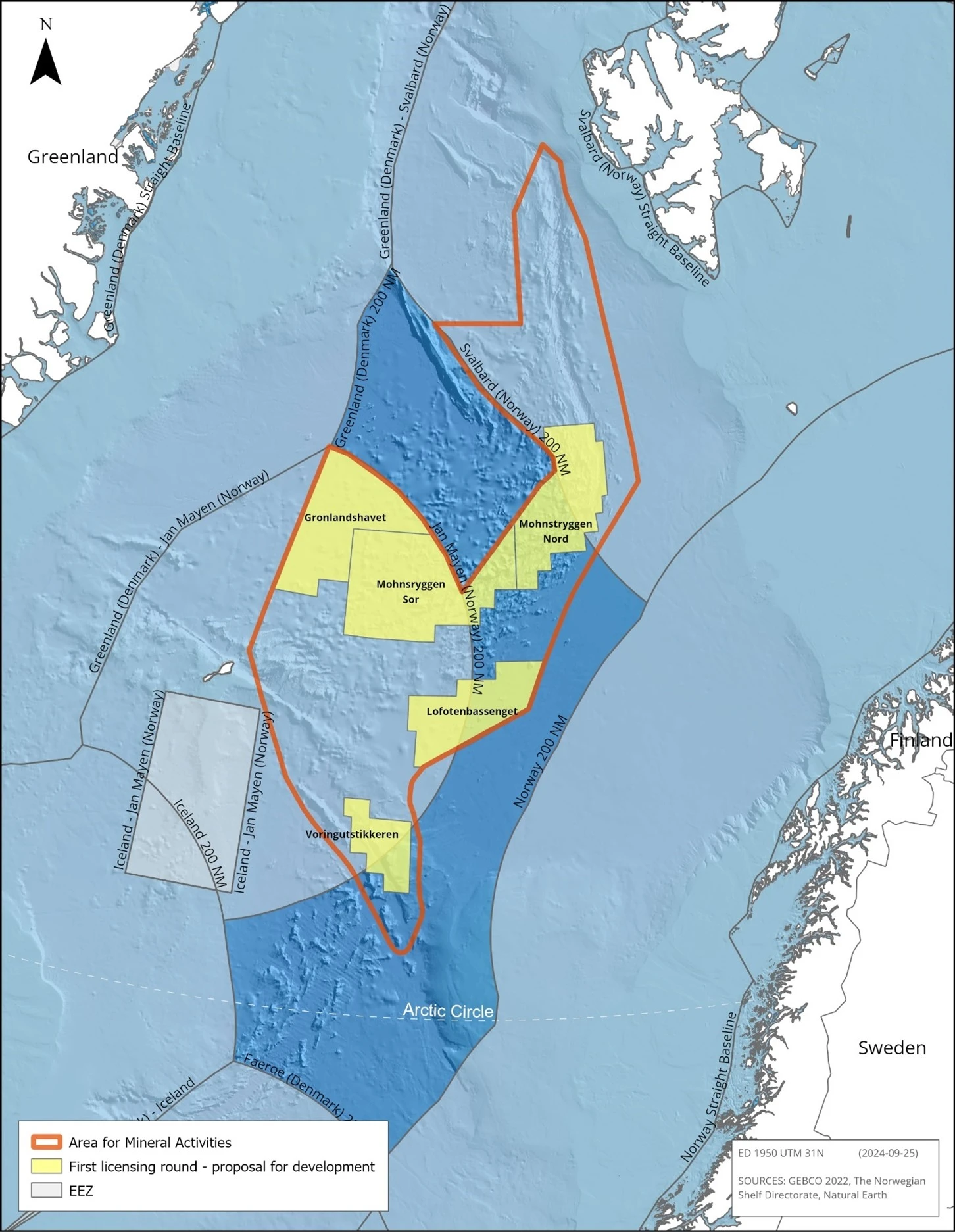
ONKN is concerned about the Norwegian Government’s decision to allow seabed mining exploration and exploitation activities in its national waters. The easternmost part of the proposed license areas borders the Greenlandic exclusive economic zone (EEZ) along the east coast of Greenland, with the other areas located relatively close by (see Figure 1). Since oceans are interconnected through currents and food webs, the environmental impacts of deep-sea mining (DSM) are inherently transboundary. Norway’s potential activities could affect Greenland’s interests, particularly its fisheries in East Greenland waters and in Norwegian and Faroese waters, e.g. for the species Atlantic cod, Greenland halibut, Haddock, Atlantic halibut, Mackerel, Saithe, Prawn, Redfish, Tusk, and Blue Whiting. Fisheries are Greenland’s most important industry and depend on a healthy marine environment. Pursuing these activities on Greenland’s doorstep could have serious consequences for the living resources that our Inuit communities rely on.
Ecosystem Impacts
Arctic ecosystems are particularly vulnerable, and large sections of the proposed licensing areas have already been designated as Especially Vulnerable and Valuable Ecological Areas in the Norwegian Ocean Management Plans. ONKN notes with deep concern that there is a substantial overlap between areas recommended for marine protection by the Norwegian Institute of Marine Research and the proposed licensing areas[1]. These are critical ecosystems that, once disturbed, may not recover. Migratory species pass through this region, including whales, which hold significant cultural and subsistence value for Inuit communities in Greenland. The potential impacts on whale populations, including impacts to migratory pathways and prey, remain unknown. Likewise, the effects on fisheries are uncertain, requiring a precautionary approach to avoid harm. ONKN is concerned over the lack of knowledge of impacts on fisheries, and the absence of any assessments of how sediment and particles from mining activities could spread, risking bioaccumulation of toxic substances. The impacts on the seabed and its associated marine life are likely to be significant and long-lasting, and the wider ecosystem impacts of destruction of these habitats are poorly understood.
Due to the limited understanding of deep-sea ecosystems, any environmental impact assessment will not be able to to establish sufficient thresholds for responsible mining practices. Gathering the scientific data necessary to mine responsibly will take decades, and would require a substantial, coordinated effort by independent scientific institutions to collect large amounts of baseline data to determine if it is even possible.
ONKN expresses its concerns about a range of potential negative impacts, including habitat destruction for vulnerable specialist species, sediment plumes, pollutants, bioaccumulation, noise and light pollution, and the spread of invasive species. ONKN emphasize the lack of knowledge about deep-sea biodiversity and ecosystems, the short- and long-term negative effects of seabed mining, the vulnerability and recovery capacity of each species, and the seabed’s capacity to store carbon dioxide.
Norway’s strategic environmental impact assessment (2023) has been criticized by civil society, scientific institutions and the government’s own expert bodies for being flawed and not meeting minimum legal requirements. The criticism centers around an insufficient assessment of the environmental impacts as well as the industrial, economic and social consequences for this large area, especially considering the transboundary nature of the impacts. ONKN echoes the Norwegian Environment Agency’s concerns about DSM and suggest a very precautionary approach to assessing the need for this industry.
The Green Transition
ONKN agrees that a green transition is essential for mitigating climate change impacts. Although, ONKN emphasizes the importance of learning from past mistakes. Sustainability should not begin with the assumption that new mineral resources must be extracted. Instead, by prioritizing reuse, recycling, and research into better utilization of mineral waste, we can significantly reduce the need for new mineral resources. From an economic perspective, many of the metals targeted by DSM are not particularly rare and have viable land-based alternatives. Some mineral resources in the deep sea exist only in small, unprofitable quantities, and DSM will not eliminate the need for land-based mines. Furthermore, there is growing concern that the international deep sea could become a geopolitical arena, leading to resource competition and potential conflicts between countries.
ONKN challenges the Norwegian Government to clearly define what ‘sustainable’ seabed mining means, especially in light of their national and international commitments (see next section). ONKN asserts that the extraction of new mineral resources can never be truly sustainable as it is inherently non-regenerative, and that the transboundary impacts of seabed mining pose too large a risk to the marine environment and habitats to be called sustainable.
International Instruments and Obligations
In accordance with the United Nations Declaration on the Rights of Indigenous Peoples (UNDRIP) and the Convention on Environmental Impact Assessment in a Transboundary Context (Espoo Convention), the Government of Greenland, along with its Indigenous Peoples, must be notified and invited to provide consultation statements on matters that will affect them. This does not only include the Government of Greenland, but also Indigenous Peoples’ Organizations, such as the Inuit Circumpolar Council – Greenland, as well as interest organizations that may be impacted by the proposed activities, such as (but not limited to) the Association of Hunters and Fishers in Greenland (KNAPK) and the National Organization of Fishers for Shellfish and Other Species (QAK). The Government of Greenland was indeed included in the consultation process for the strategic impact assessment and did request to be included again when the plans became more concrete, which can be said is the case now.
ONKN also reminds Norway of its national and international obligations to protect the marine environment and ecosystems, as well as to apply the precautionary principle. These obligations include compliance with the Norwegian Nature Diversity Act, the Norwegian Environmental Information Act (which implements the Aarhus Convention), the Svalbard Treaty, the Sustainable Development Goals (SDGs), the Convention on Biological Diversity (CBD) and the Kunming-Montreal Global Biodiversity Framework (GBF), Articles 206 and 208(1) of the United Nations Convention on the Law of the Sea (UNCLOS), and the Convention for the Protection of the Marine Environment of the North-East Atlantic (OSPAR).
ONKN’s position
ONKN supports a global moratorium on DSM until further research is conducted into these poorly understood ecosystems and the potential impacts on the marine environment, both locally and globally – and until it can be clearly demonstrated that deep seabed mining can be managed in such a way that prevents harm to the marine environment and prevents loss of biodiversity. A thorough understanding of the environmental risks, along with effective management and protection measures, must be in place before any mining activities proceed. Globally, efforts should focus on developing a sustainable, circular economy to reduce the need for new minerals and avoid the potential risks associated with DSM.
In summary, the potential impacts on Arctic deep-sea ecosystems are significant, transboundary, and possibly irreversible. ONKN urges the Norwegian Ministry of Energy to withdraw its proposal for licensing areas on the seabed until comprehensive and sufficient studies on the impacts of DSM are completed and only if it is clear that there is a path forward for responsible, sustainable development. In addition, ONKN urge the Norwegian Government to reconsider its position on DSM in light of the necessity to transition to a circular economy.
Best regards,
Jenseeraq Poulsen
Executive Director, Oceans North Kalaallit Nunaat
+299 483467
cc: This letter has also been sent to the Greenlandic Minister for Mineral Resources – Naaja H. Nathanielsen, the Greenlandic Minister for Environment – Kalistat Lund, and the Greenlandic Minister for Fisheries and Hunting – Kim Kielsen, as well as to the Indigenous Peoples’ organization Inuit Circumpolar Council – Greenland, and the following interest organizations: Sustainable Fisheries Greenland (SFG), the Association of Fishers and Hunters in Greenland (KNAPK), and the National Organization of Fishers for Shellfish and Other Species (QAK).
[1]Legrand, E., Boulard, M., O’Connor, J., & Kutti, T. (2024). Identifying priorities for the protection of deep-sea species and habitats in the Nordic Seas. https://hdl.handle.net/11250/3122403


